

HULL REPAIR
HULL REPAIR FORT LAUDERLADE DIAGNOSIS
HOW TO DETERMINE IF IT’S TIME TO REPAIR YOUR BOAT’S HULL NEAR ME?
Let’s face it, no one gets excited about the idea of cutting a giant hole into the side of their boat (except for maybe us here at EYS). However, there are times when it’s a necessary evil in order to stay afloat. Most of our previous clients who came to us seeking hull repair services were concerned about deterioration spots, cracks, or leaks. All of these are signs of corrosion.
So, what is corrosion and why is it happening to your boat? Simply put, corrosion happens when moisture accumulates in one specific area for a prolong period of time causing your steel or aluminum hull to deteriorate and oxidize, or how we normally say, “rust”. Although rust is a visible indicator that your hull may be compromised, there may also be other underlying issues that are not visible to the naked eye. Visible or not, the question is how do you know the damage to the hull’s wall is bad enough to seriously begin considering repairs?
HULL WALL TESTING
Fortunately, there are a few different types of tests that can be done to detect internal and surface hull imperfections before performing a hull repair. Internal hull imperfections can be detected by ultrasonic or radiographic testing. Ultrasonic and radiographic testing are just fancy words used to describe two methods of taking a closer internal look at your hull wall. Ultrasonic testing is performed using sound waves to output the precise measurement of the hull plate’s thickness. Radio graphic waves use x-rays. Both methods are used to produce the same result. We typically use ultrasonic wall measuring instruments to pinpoint the hull plate areas that need to be replaced.
Surface imperfections can be detected through liquid penetrant testing and magnetic particle testing. These testing methods are typically used by ABS Lloyd’s surveyors to ensure welding repairs are satisfactory to code.
After thoroughly testing the hull, we assess the damage and determine how many areas have to be replaced. If the damage is extensive, parts of the internal frame of the hull may also have to be removed.
ASSESSING HULL DAMAGE & PERFORMING A HULL REPAIR NEAR ME
DETERMINING AN ENTRY POINT
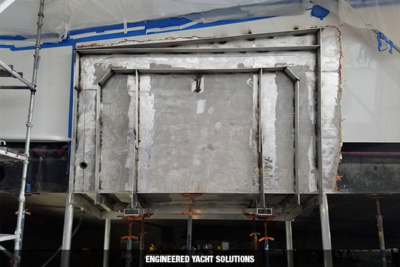
The next step is determining where to cut. If the corrosion on the hull is minimal only a small cut on the side of the hull will be necessary. However when the damage is extensive, larger cuts will have to be made and in rare cases some deck space may have to be removed.
For example, on one of our previous projects we found visible damage at the exterior hull plate and at the welds on the interior hull frames. In order to fix the problem we decided to make two cuts. The first cut was made at the damaged hull plate located at the nose of the bow. The second cut was an access hole mad into the bulwark. This access hole was in between the teak and top of the bulwark and directly behind the hull repair. Creating an access hole here allowed for a complete weld to the backside of the plate repair and for access to the interior hull frames. After the completion of all the repairs, the access hole was covered and welded and the 115 footer was stronger than ever.
PROTECTION, SCAFFOLDING, AND CONTAINMENT
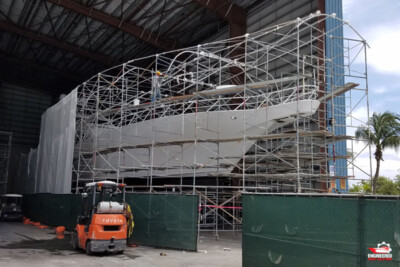
First things first, before any work begins on the vessel we make sure to lay down the protection. We start off ensuring that all the repair entry points are protected. Engineered Yacht Solutions specializes in servicing all types of marine vessels, including luxury super yachts, naval ships, fishing boats, sail boats, and more.
We understand how important it is for our customers to preserve the cosmetic integrity of their vessel. That’s why we take all the necessary precautions to protect your boat while we conduct repairs.
HULL SUPPORT FRAMES
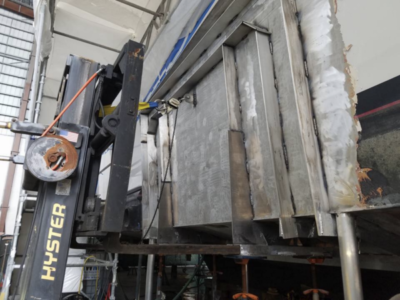
Support frames can be fabricated if additional support is required. Extra reinforcements may be needed if large portions of the hull’s frame are being replaced.
The added frames supply temporary support while the rusted plate and frames have been removed. This will help maintain the integrity of the hull’s structure and avoid any misshape. These provisional frames eventually are removed just as new plate installation begins.
FORKLIFT PLATFORM
Forklift platforms can be fabricated to facilitate the hull cut transportation. Forklift platforms are steel inserts welded on to the bottom of the hull that are used to basically “catch” and transport the piece that gets removed. The steel inserts are designed to accept the insertion of the forklifts legs perfectly. These steel structures also create load stability in case there is machinery attached to the plate being removed.